
Overtime Tax Deduction vs Overtime Tax Withholding
Last updated: October 2026
Your overtime check looks small after taxes, yet your tax return may send money back. Two separate systems cause that. Withholding takes tax out of every paycheck, while the overtime deduction lowers your tax bill at filing time. An overtime tax calculator shows both numbers side by side. This guide explains how each one works, why they rarely match, and what you can change to keep more money in your paycheck.
Table of Contents
- What Is the Difference Between the Overtime Deduction and Withholding?
- How Does Overtime Withholding Work on Your Paycheck?
- How Does the Overtime Tax Deduction Work at Filing Time?
- Why Do Withholding and the Deduction Create a Refund Gap?
- Should You Change Your W-4 for Overtime?
- How Does an Overtime Tax Calculator Compare the Two?
- What Mistakes Mix Up Withholding and the Deduction?
- Quick Answers
- Final Thoughts
What Is the Difference Between the Overtime Deduction and Withholding?
Withholding is a payment. The deduction is a calculation. Your employer collects withholding on every payday as a prepayment toward your yearly tax bill. However, the deduction exists only on your return, where it lowers your taxable income.
So the two never cancel each other automatically. One moves money during the year, and the other settles the final amount.
| Feature | Overtime Withholding | Overtime Tax Deduction |
|---|---|---|
| Who handles it | Your employer | You, on your return |
| When it happens | Every paycheck | At filing time |
| What it does | Prepays your tax | Lowers taxable income |
| What it covers | All overtime pay | Only the FLSA premium |
| Limits | None | $12,500 single, $25,000 joint |
| Form | Form W-4 | Schedule 1-A |
How Does Overtime Withholding Work on Your Paycheck?
Employers must withhold federal income tax from overtime wages. They also withhold Social Security and Medicare tax. The deduction changes none of this.
Employers pick one of two methods for the income tax part:
- Regular wage method: The employer adds overtime to your regular pay and uses the standard withholding tables.
- Supplemental method: The employer withholds a flat 22% from the overtime payment.
Publication 15 allows employers to treat overtime as regular wages instead of supplemental wages. As a result, two workers with identical overtime can see different withholding.
Also, the flat 22% is a prepayment, not your tax rate. Your real rate depends on your bracket when you file.
For example, a $900 overtime payment can lose $198 to the flat 22% rate before Social Security and Medicare. Your paycheck shrinks right away. However, your final tax may turn out much lower.
Source: IRS Publication 15 (2026).
How Does the Overtime Tax Deduction Work at Filing Time?
The deduction covers only the premium. For time-and-a-half pay, that means the extra half of your hourly rate. Meanwhile, your regular rate on those hours stays fully taxable.
Keep these rules in mind:
- The cap is $12,500 for single filers and $25,000 for joint filers.
- The deduction runs for tax years 2025 through 2028.
- It shrinks by $100 for every $1,000 of MAGI above $150,000 (single) or $300,000 (joint).
- You claim it on Schedule 1-A, and you do not need to itemize.
Starting with tax year 2026, employers report the qualified amount in Box 12, code TT of your W-2. Therefore, you can generally deduct only that reported amount. Read the deduction rules explained for the full eligibility list.
Source: IRS Fact Sheet FS-2026-13.
Why Do Withholding and the Deduction Create a Refund Gap?
A short example shows the gap. Dana files as single and earns $20 per hour, so her overtime rate is $30. She works 300 overtime hours and sits in the 12% bracket. Her employer withholds a flat 22% on overtime, and her regular paychecks withhold the right amount.
| Item | Amount |
|---|---|
| Gross overtime pay | $9,000 |
| Withheld at flat 22% | $1,980 |
| Qualified premium ($10 × 300) | $3,000 |
| Tax on overtime without deduction (12%) | $1,080 |
| Tax on overtime with deduction | $720 |
| Extra tax withheld | $1,260 |
Notice how that $1,260 splits. The deduction itself saves $360 ($3,000 × 12%). The other $900 is over-withholding, because her employer withheld 22% on income taxed at 12%.
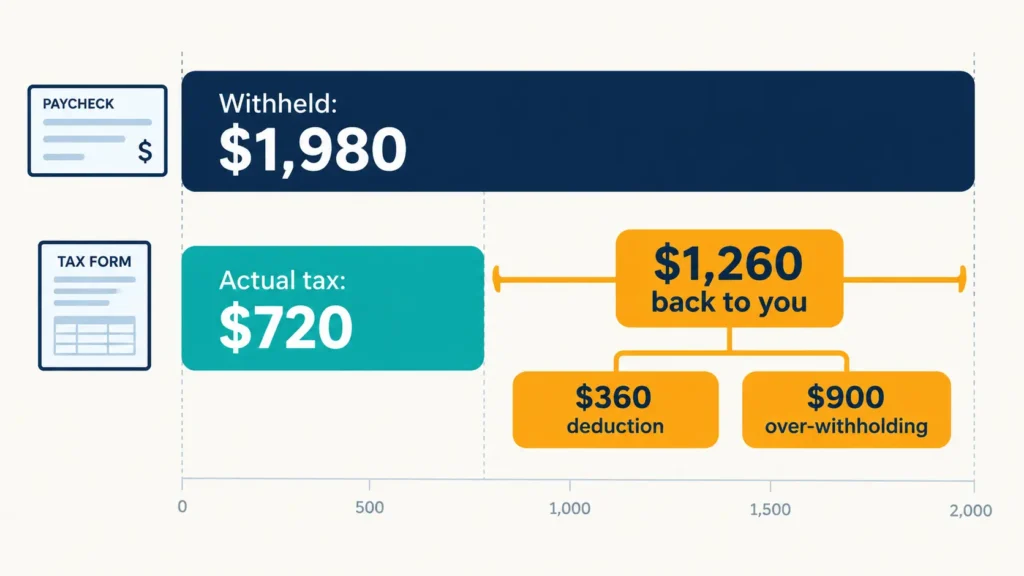
Many workers credit the deduction for their entire refund bump. However, over-withholding explains most of it here. That money was always hers, so the deduction did not create it.
The gap changes with your bracket. In the 22% bracket, the flat rate matches your real rate, so the deduction explains almost the whole difference. In the 10% bracket, over-withholding grows even larger, and it can outweigh the deduction.
Should You Change Your W-4 for Overtime?
Employers cannot reduce your withholding for the deduction on their own. Instead, they can do it only after you submit an updated Form W-4.
The 2026 Form W-4 lets you enter the expected deduction in Step 4(b). For Dana, entering $3,000 would cut about $360 of yearly withholding, or roughly $30 per month.
Follow these steps before you change anything:
- Enter your premium estimate, not your total overtime pay.
- Reduce the estimate if your MAGI nears the phase-out range.
- Check your entries with the IRS Tax Withholding Estimator.
- Ask payroll how Step 4(b) applies if your employer uses the flat 22% method.
- Update the form again if your overtime hours drop.
Above all, avoid a hopeful estimate. Too little withholding means a bill in April.
Also, compare your year-to-date withholding with your expected tax each quarter. A quick check in July or October leaves time to fix a gap before year-end.
How Does an Overtime Tax Calculator Compare the Two?
An overtime tax calculator puts withholding and the deduction in one view. Look for three outputs: the tax withheld per paycheck, the qualified premium, and the estimated refund impact.
Enter your regular rate, overtime hours, and filing status. Then the tool separates the premium from your full overtime pay. You can estimate your overtime tax in under a minute, or use an overtime refund estimator to preview your return.
Still, treat every result as an estimate, not exact figures. Your final return decides the real number.
What Mistakes Mix Up Withholding and the Deduction?
- Treating the flat 22% as your tax rate
- Crediting the deduction for your whole refund
- Expecting bigger paychecks without a new W-4
- Entering total overtime pay instead of the premium
- Skipping the W-2 check for Box 12, code TT
- Forgetting state tax, because the deduction is federal only
Quick Answers
Does the deduction lower my overtime withholding automatically?
No. Your employer cannot reduce withholding for the deduction on its own. You must submit an updated Form W-4 first. Then your employer can adjust the tax taken from each paycheck.
Source: IRS Publication 15 (2026).
Does overtime pay still have Social Security and Medicare tax?
Yes. Both taxes apply to every overtime dollar. The deduction lowers only your federal income tax. Your payroll taxes stay the same.
Source: IRS Publication 15 (2026).
What happens if my income is above the phase-out limit?
The deduction drops by $100 for every $1,000 of MAGI over the limit. The phase-out starts at $150,000 for single filers and $300,000 for joint filers. The deduction ends completely at $275,000 (single) and $550,000 (joint).
Source: IRS Fact Sheet FS-2026-13.
Can I claim more than my W-2 shows?
Generally no. For 2026, you can claim only the amount in Box 12, code TT. If it looks wrong, ask your employer for a corrected Form W-2c. Then wait for the new form before you file.
Source: IRS Fact Sheet FS-2026-13.
Final Thoughts
Withholding moves money during the year. The deduction settles the bill at filing time. Knowing which one does what helps you read your paycheck and your refund correctly.
So check your W-4 now, compare your W-2 in January, and run your numbers before you file. This article offers general information, so consider a tax professional for personal advice.

Hi, I’m Sultan Mehmood, founder of NoTaxOnOvertimeCalculator.net. I started this site in 2026 to make overtime pay and tax topics easy to understand. I create simple calculators and clear guides on overtime pay, tax deductions, and take-home salary.