
Overtime Tax Refund Calculator 2026: Tax Savings Explained
If you worked extra hours this year, an overtime tax refund calculator can show you what the federal overtime deduction is actually worth to you in real dollars. Since 2025, overtime-eligible employees can deduct a portion of their overtime pay from federal taxable income under the One Big Beautiful Bill Act (OBBBA). The deduction lowers your federal income tax, so the savings are often smaller than people expect.
The deduction lowers your federal income tax, so the savings are often smaller than people expect. Whether you get a refund depends on how much tax your employer withheld from your pay during the year. This guide walks through exactly how the estimate works, what limits apply, and which mistakes most often throw the numbers off.
Table of Contents
- What Is the Overtime Tax Refund Calculator?
- Why “No Tax on Overtime” Isn’t Fully Tax-Free
- How Overtime Tax Savings Are Calculated
- Overtime Tax Refund Estimates by Income and Filing Status
- Overtime Tax Refund Calculator: Key Limits at a Glance
- Common Mistakes That Shrink Your Refund Estimate
- Frequently Asked Questions
What Is the Overtime Tax Refund Calculator?
The overtime tax refund calculator estimates how much of your overtime pay you can deduct under the federal “no tax on overtime” provision, and how much that deduction is worth once it reaches your return. It does not calculate your full refund. Instead, it isolates just the slice tied specifically to overtime, since that slice follows its own separate rules.
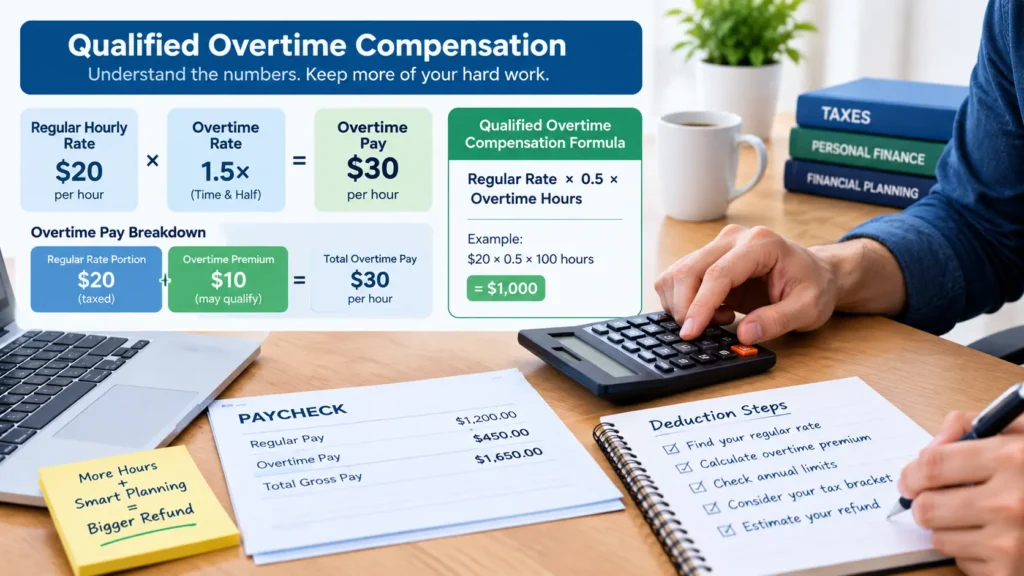
This distinction matters because the deduction only covers the “premium” half of time-and-a-half pay, not the entire overtime paycheck. In other words, if you earn $30 an hour and get paid $45 for overtime hours, only the extra $15 per hour counts toward the deduction. The base $30 portion is taxed exactly the same way it always was, before this law existed.
Because the calculator only touches that premium slice, it works best as a planning tool rather than a substitute for your actual tax software. Before you dig into the numbers below, it helps to run your own estimate using your actual hours and pay rate, since national averages rarely match an individual paycheck or filing situation.
Why “No Tax on Overtime” Isn’t Fully Tax-Free
The name of this provision suggests overtime becomes completely tax-free, but that isn’t accurate, and the gap between the name and the reality is where most confusion starts. Social Security and Medicare taxes still apply to every single dollar of overtime pay, with no exception carved out.
Additionally, this is a federal-only change, so many states may still tax overtime income in full. Check your state’s rules separately. The federal deduction only reduces the income tax portion of your bill, and even then, only on the premium half of the pay, not the full overtime amount you actually received.
How Overtime Tax Savings Are Calculated
Three factors work together to determine your tax savings, and each one changes the outcome in a different way:
- The overtime premium. Multiply your overtime hours by half of your regular hourly rate to isolate the deductible portion. This premium amount, not your full overtime earnings, is what actually qualifies for the deduction, so skipping this step is the single most common source of an inflated estimate.
- The annual cap. The deduction cannot exceed $12,500 for single or head-of-household filers, or $25,000 for joint filers, no matter how much overtime you worked during the year. Once your premium reaches that ceiling, any additional overtime hours simply stop adding to the deduction.
- Your tax bracket. The dollar value of the deduction depends entirely on your marginal federal tax rate, so identical deduction amounts produce noticeably different savings for different earners. Someone in the 22% bracket keeps nearly double what someone in the 12% bracket keeps from the same deducted dollar.
The deduction is calculated in Part III of Schedule 1-A (lines 14 to 21). The total additional deduction is reported on Form 1040, line 13b.
For a clearer, step-by-step walkthrough of these three factors with worked examples, see how the deduction works before running your own scenario through the numbers. Once you know your deductible amount, multiply it by your marginal tax rate to arrive at your estimated savings. This is the figure that lowers your tax bill or grows your refund at filing time, not a separate check that shows up on its own.
Overtime Tax Refund Estimates by Income and Filing Status
The table below shows representative outcomes across different income levels. These are estimates, not guarantees, since actual results depend on your full tax situation.
| Filing Status | Total Overtime Pay (time-and-a-half) | Deductible Premium | Est. Tax Bracket | Est. Tax Savings |
|---|---|---|---|---|
| Single | $4,000 | $1,333 | 12% | ~$160 |
| Single | $9,000 | $3,000 | 22% | ~$660 |
| Single | $18,000 | $6,000 | 24% | ~$1,440 |
| Married Filing Jointly | $10,000 | $3,333 | 12% | ~$400 |
| Married Filing Jointly | $22,000 | $7,333 | 22% | ~$1,613 |
| Married Filing Jointly | $40,000 | $13,333 | 24% | ~$3,200 |
As the table shows, the refund grows with both overtime hours and income bracket, but only up to the annual cap. Beyond that point, additional overtime no longer increases the deduction.
Overtime Tax Refund Calculator: Key Limits at a Glance
- Maximum deduction. The cap sits at $12,500 for single or head-of-household filers, and $25,000 for those married filing jointly, and this ceiling applies per return rather than per job or per employer.
- Phase-out range. The benefit begins shrinking once modified adjusted gross income (MAGI) crosses $150,000 for single filers or $300,000 for joint filers, and it disappears completely at $275,000 and $550,000 respectively.
- Qualifying overtime only. Only the FLSA-required premium counts. Bonuses, shift differentials, and any extra premium beyond the FLSA requirement, such as double-time paid under state law, do not count toward this deduction.
- Filing requirements. A valid Social Security number is required to claim the deduction, and married taxpayers must file a joint return rather than filing separately if they want to use it.
- Reporting timeline. For the 2025 tax year, most workers self-report their premium using pay stubs and reasonable estimation methods. Starting with the 2026 tax year, employers must report the qualifying amount on Form W-2 in Box 12, code TT, and you can generally deduct only the amount reported there.
Common Mistakes That Shrink Your Refund Estimate
Several recurring errors throw off refund estimates before anyone even opens a calculator:
- Using total overtime pay instead of just the premium. Plugging in the full time-and-a-half amount rather than isolating the extra half overstates the deduction by roughly three times, which then produces an estimate that will not match your actual return.
- Ignoring the phase-out entirely. Higher earners frequently assume the full $12,500 or $25,000 cap automatically applies to them, only to discover during filing that their MAGI has already reduced the usable amount.
- Counting non-FLSA overtime as qualifying. State-mandated daily overtime, seventh-day premiums, and overtime paid under a collective bargaining agreement beyond FLSA requirements do not count toward this specific federal deduction, even though they are still real income.
- Forgetting that FICA still applies in full. Because Social Security and Medicare withholding never changes under this provision, and employers can’t reduce income tax withholding automatically, your paycheck stays the same unless you submit an updated Form W-4. The benefit usually appears later on the tax return itself.
- Assuming a $0 result means an error. A result of zero often means the worker is classified as exempt under federal labor law, so there is no qualifying premium to deduct. It can also mean zero overtime hours were entered. MAGI is at or above $275,000 for single filers or $550,000 for married filing jointly, where the deduction is fully phased out.
Frequently Asked Questions
What’s the difference between an overtime tax refund calculator and a regular tax refund calculator?
A regular tax refund calculator projects your entire return, factoring in every deduction, credit, and withholding line on your return. An overtime tax refund calculator instead isolates one specific piece: the federal savings created by the overtime premium deduction. Combining the two gives the fullest picture, since the overtime figure is meant to feed into a larger return rather than stand on its own.
What information do I need to get an accurate refund estimate?
At minimum, you need your regular hourly rate, your total overtime hours for the year, and your filing status, since these three inputs generate the qualifying premium. Adding your approximate MAGI sharpens the estimate further by accounting for the phase-out range. The more precisely these numbers match your actual pay records, the closer the estimate lands to your real outcome at filing time. For tax year 2026, compare your estimate with the Box 12, code TT amount on your 2026 W-2, which is issued in early 2027.
Why might my tax savings estimate show $0?
A $0 result usually points to employment classification or eligibility rather than a calculator error. Employees classified as exempt under the Fair Labor Standards Act are not entitled to mandatory overtime pay, so there is no qualifying premium to deduct. A $0 can also appear if MAGI is above the phase-out limit, the filing status is married filing separately, or no overtime hours were entered. Checking your pay stub or asking your employer about your FLSA status clarifies this quickly.
Can both spouses claim the overtime deduction on a joint return?
Yes, but the $25,000 cap applies to the joint return as a whole, not separately to each spouse. If both partners earn qualifying overtime during the year, their individual premiums are added together first, and the combined total is then capped at that single shared limit before the tax savings are calculated.
Is the overtime deduction paid as a separate check?
No. The deduction lowers your taxable income, which lowers your total tax on the return. You receive extra money only if your total withholding is more than your total tax. The deduction lowers your taxable income on Schedule 1-A, which then flows into your overall tax calculation alongside every other deduction and credit you claim. There is no separate check or notification tied specifically to the overtime portion.
Final Thoughts
An overtime tax refund calculator turns a confusing federal deduction into a concrete number you can plan around. The savings are real, but they apply only to the premium portion of your pay, and they phase out at higher incomes. Running your specific hours and rate through the numbers, rather than relying on general averages, gives the most reliable picture of what to expect at filing time.
Sources
IRS Revenue Procedure 2025-32; IRS Notice 2025-69; IRS Schedule 1-A instructions; IRS Questions and Answers on the new deduction for qualified overtime compensation.
State Tax Note
State tax rules may differ from the federal deduction, so check your state’s rules.

Hi, I’m Sultan Mehmood, founder of NoTaxOnOvertimeCalculator.net. I started this site in 2026 to make overtime pay and tax topics easy to understand. I create simple calculators and clear guides on overtime pay, tax deductions, and take-home salary.