
How Much Overtime Can You Deduct in 2026?
Last updated: October 23, 2026. Based on IRS Fact Sheet FS-2026-13 (August 2026).
Marcus works nights at a warehouse. Last winter, he picked up extra shifts for months, and his pay stubs looked great. Then tax season came, and a friend told him, “Overtime is tax-free now!” Marcus believed it. However, he was wrong, and that mistake could have cost him.
Before you make the same mistake, run your numbers in an overtime tax calculator. It takes two minutes and shows what you can really deduct. In this guide, you will also learn the exact limits, how the income phase-out works, and what to do if your W-2 is wrong.
The Short Answer: Up to $12,500, But Only on the “Half”
Here is the answer in plain words:
- Single filers and heads of household can deduct up to $12,500.
- Married couples filing jointly can deduct up to $25,000.
- The limit is per tax return, not per job. Overtime from all your jobs adds together.
- The deduction covers tax years 2025 through 2028, and the same limits apply under current law.
- You get it whether or not you itemize.
| Filing Status | Maximum Deduction | Starts to Shrink at MAGI | Reaches $0 at MAGI |
|---|---|---|---|
| Single or head of household | $12,500 | $150,000 | $275,000 |
| Married filing jointly | $25,000 | $300,000 | $550,000 |
Now, the part most people miss. You do not deduct your full overtime pay. Instead, you deduct only the extra half of “time and a half.” That one detail decides everything.
Why “No Tax on Overtime” Is a Bad Name
The name does more harm than good. It makes workers expect a tax-free paycheck, and that is not what the law gives.
It is a deduction, not an exemption. Here is what stays the same:
- Social Security tax still applies to your overtime.
- Medicare tax still applies.
- Your employer still withholds federal income tax.
- Your state may still tax every dollar, because state rules vary.
The deduction only lowers your taxable income when you file. Think of it as a discount at the end, not a free pass at the start.
Is It a Tax Credit or a Deduction?
Many people search for the “overtime tax credit,” but this is a deduction. The difference matters. A credit cuts your tax bill dollar for dollar. A deduction, however, only cuts the income that gets taxed. As a result, your tax bracket decides what each deducted dollar is worth.
How Do You Figure Out Your Overtime Deduction?
You can do this by hand in a few minutes. Follow these steps for each workweek:
- Find your regular hourly rate. It includes most pay tied to your work, such as production bonuses.
- Count your overtime hours, meaning the hours over 40 in a workweek.
- Take half of your regular rate.
- Multiply that half-rate by your overtime hours.
- Add up all your weeks for the year.
- Compare the total with Box 12, code TT on your W-2.
- Apply the cap and the income phase-out.
Qualified overtime = overtime hours over 40 × ½ × your regular rate
For a deeper walkthrough, read how the overtime deduction works step by step.
Marcus’s Real Numbers
Let’s go back to Marcus. He earns $24 an hour, so his overtime rate is $36. Here is what counts:
- Regular rate: $24
- Overtime rate: $36
- Premium: $12 (the only part that qualifies)
Marcus works 10 overtime hours a week for 50 weeks. That is 500 hours, and 500 × $12 = $6,000 of deduction. Marcus thought his deduction would be $18,000. In reality, it was one-third of that. Learning this in January is better than learning it from an IRS letter.
What Does $6,000 Actually Save You?
A deduction is not a refund. Your tax bracket decides the savings:
| Tax Bracket | Tax Saved on a $6,000 Deduction |
|---|---|
| 10% | $600 |
| 12% | $720 |
| 22% | $1,320 |
| 24% | $1,440 |
That is real money, but it is not $6,000. Anyone who says otherwise is selling something. For more detail, see why overtime keeps your normal tax rate. Also, you can estimate your overtime tax refund with your own numbers.
According to news reports of IRS filing data, more than 29 million taxpayers claimed this deduction for tax year 2025 by the April deadline. So Marcus is far from alone.
How Many Overtime Hours Does It Take to Reach the Cap?
Most workers never reach the cap. The reason is simple: only half of your hourly rate counts.
| Regular Hourly Rate | Deductible per Overtime Hour | Hours to Reach $12,500 | Hours per Week (50 Weeks) |
|---|---|---|---|
| $20 | $10.00 | 1,250 | 25 |
| $30 | $15.00 | 833 | 17 |
| $40 | $20.00 | 625 | 12.5 |
| $50 | $25.00 | 500 | 10 |
Joint filers need twice as many hours to reach $25,000. Therefore, for most workers, the cap is not the number to watch. Your bracket and your records matter more.
Who Can Claim It? Check This List First
Many people fail on small rules. Go through this list before you get excited:
- You must earn FLSA overtime. This usually means being a W-2 employee. Gig workers and independent contractors do not qualify.
- Your overtime must be required by the Fair Labor Standards Act (FLSA).
- You need a Social Security number that is valid for work.
- Married couples must file jointly. “Married filing separately” is out.
- Your income must be under the phase-out limit, or you get a smaller deduction.
- For 2026 and later, your employer must report the amount on your W-2.
If you miss one item, the deduction can shrink or vanish. To check your own case, see who qualifies for the overtime tax deduction.
When Your Overtime Doesn’t Count
This is where most workers get hurt. Some overtime pay looks the same on your stub but does not qualify.
These do not count:
- State-required overtime that goes beyond federal rules, such as daily overtime after 8 hours
- Union contract premiums above the FLSA amount
- Holiday or weekend pay for hours that are not overtime hours over 40
- Overtime for exempt workers, such as many executives and some professionals
- Owners who hold 20% or more of the business and help run it, because the IRS treats them as exempt
Here is an example. Suppose you earn $24 an hour, and your employer pays double time ($48) for hours over 40. Only the FLSA part, the $12 premium, counts. The other $12 does not. In contrast, if you work a holiday but stay under 40 hours, none of that extra holiday pay counts.
This rule trips up workers in states with strict overtime laws. Payroll teams are still learning it, too.
How Does the Income Limit and Phase-Out Work?
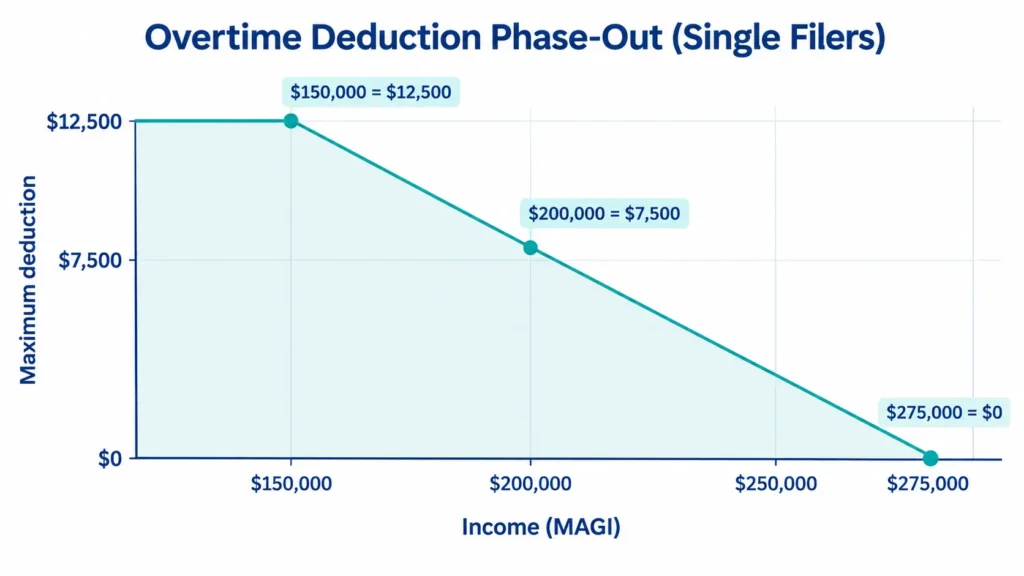
The deduction shrinks as your income rises. The measure is your modified adjusted gross income (MAGI). For most people, MAGI is close to regular adjusted gross income. The Schedule 1-A instructions show the exact steps.
The rule is simple: you lose $100 of deduction for every $1,000 of MAGI above the starting line.
Example 1 (single): MAGI of $160,000 is $10,000 over the line. The loss is 10 × $100 = $1,000, so the new cap is $11,500.
Example 2 (joint): MAGI of $350,000 is $50,000 over the line. The loss is $5,000, so the new cap is $20,000.
Phase-Out Chart: Single or Head of Household
| MAGI | Maximum Deduction |
|---|---|
| $150,000 or less | $12,500 |
| $160,000 | $11,500 |
| $180,000 | $9,500 |
| $200,000 | $7,500 |
| $220,000 | $5,500 |
| $240,000 | $3,500 |
| $260,000 | $1,500 |
| $275,000 or more | $0 |
Phase-Out Chart: Married Filing Jointly
| MAGI | Maximum Deduction |
|---|---|
| $300,000 or less | $25,000 |
| $350,000 | $20,000 |
| $400,000 | $15,000 |
| $450,000 | $10,000 |
| $500,000 | $5,000 |
| $550,000 or more | $0 |
The chart shows the highest deduction you can take. If your qualified overtime is smaller, your deduction is smaller too. In other words, you get the lower of the two numbers.
If a second job lifts your income, watch this closely. One side gig can cost you hundreds of dollars.
Using an Overtime Tax Calculator the Smart Way
An overtime tax calculator is a quick tool, but it only helps if you feed it the right numbers. Most people type in total overtime pay. That is the wrong number.
Use these inputs instead:
- Your regular hourly rate
- Your overtime hours beyond 40 per week
- Your filing status
- Your expected yearly income
Then compare the result with your pay stubs. If the two differ a lot, find out why. The cause is usually state-law overtime or a bonus. For help, see how to use an overtime tax calculator correctly. Do this early in the year, not in April, because early numbers give you time to fix problems.
The 2026 W-2 Change That Helps You
Tax year 2025 was messy. Employers did not have to report qualified overtime separately, so workers dug through pay stubs and estimated.
That changes in 2026. Employers must now report the qualified amount on your W-2:
- It appears in Box 12.
- It uses code TT.
- You will get it in early 2027.
This is good news, because you no longer have to build the number yourself. However, there is a catch. For 2026 and later, you can only deduct the amount shown on your W-2. To learn more, read what W-2 Box 12 code TT means.
Note that the TT amount can be higher than your deduction. For example, if your employer reports $30,000, your deduction is still capped at $12,500 (or $25,000 on a joint return).
Found a Mistake on Your W-2? Do This
You cannot fix the number yourself. If you write a different amount on your return, you invite trouble.
Follow these steps:
- Compare your W-2 with your pay stubs.
- Spot the gap, if any.
- Ask your employer for a corrected W-2 (called a W-2c).
- Wait for the new form before you file.
Keep in mind three rules:
- If your employer will not correct a low amount, you can only use the lower number on the W-2.
- A substitute W-2 (Form 4852) cannot be used for this deduction.
- If the amount is too high, you can only use what you were actually paid.
Also, keep your last pay stub of the year. It is your proof if anyone asks questions.
Where Do You Claim the Deduction?
You claim it on Schedule 1-A of Form 1040, in Part III. The last line of Part III is your deductible amount. You do not need to itemize. Instead, you take it on top of the standard deduction.
Don’t Forget Your W-4
Your paycheck does not change on its own. Your employer keeps withholding at the old rate unless you update your W-4. That has two sides:
- Too much withholding: you lend the government money all year.
- Too little withholding: you may owe a bill in April.
The 2026 W-4 has a spot for expected qualified overtime in Step 4(b). Fill it in with a careful estimate, not a hopeful one. The IRS Tax Withholding Estimator can help, too. Review your numbers again around mid-year, because if your overtime drops, your estimate should drop as well.
Five Mistakes That Cost Workers Money
The same errors come up again and again. Avoid these:
- Deducting the full overtime pay. Only the premium counts.
- Counting state or union extras. Only the FLSA part qualifies.
- Filing separately while married. You lose the deduction.
- Ignoring a second job’s income. It can trigger the phase-out.
- Skipping the pay stub check. A wrong W-2 can delay your refund, so compare it early.
Fix these five, and you are ahead of most filers. For real numbers, see overtime deduction examples by income level.
A Simple Plan for the Rest of 2026
You do not need to be a tax expert. You need a routine. Try this:
- Today: Find your regular rate and overtime hours.
- This week: Estimate your premium total.
- This month: Check your W-4.
- Every quarter: Track your overtime hours.
- In January: Compare your W-2, Box 12, code TT, with your records.
That is five small steps, and together they protect hundreds of dollars.
Common Questions
Is there an income limit for the overtime deduction?
Yes. The deduction starts to shrink at $150,000 of MAGI for single filers and $300,000 for joint filers. It reaches $0 at $275,000 and $550,000.
What is the maximum overtime deduction?
The maximum is $12,500 for single filers and $25,000 for joint filers. You can only reach it if your qualified overtime is at least that large and your income is under the phase-out line.
Do I need to itemize to claim the overtime deduction?
No. You can take it even when you use the standard deduction. Most workers do not itemize, so this keeps the break open to almost everyone.
Does this deduction lower my adjusted gross income?
No. It comes off after your adjusted gross income is set. As a result, other tax rules that depend on that number will not change.
Is my overtime now free of Social Security and Medicare tax?
No. Payroll taxes still apply to every overtime dollar. Only your federal income tax bill gets the discount.
Can a contractor or gig worker claim it?
Usually not. The break is built for employees who earn FLSA overtime. In rare cases, a worker is an FLSA employee but is treated as a contractor for tax purposes. If you work for yourself, a tax professional can check your case.
What if my employer reports the wrong amount on my W-2?
Ask for a corrected W-2c and wait for it. Do not write your own number on the return. A fix at the source keeps your filing clean.
Does double-time pay count in full?
No. Only the portion the FLSA requires counts. Extra holiday or weekend premiums add to your paycheck, but not to your deduction.
Does the deduction expire?
Yes. It applies to tax years 2025 through 2028 only. Overtime you earn after 2028 will not qualify unless Congress extends the rule.
Final Thoughts: Check Your Numbers Before You File
The overtime deduction is real, and it can save you money. However, it is smaller and stricter than the headlines suggest.
Remember these points:
- Only the premium half counts.
- Only FLSA overtime qualifies.
- Your W-2 Box 12, code TT number is the one that matters.
- A quick W-4 update can put the benefit in your paycheck sooner.
Marcus learned that his $18,000 guess was really a $6,000 deduction. He checked his numbers, fixed his W-4, and filed with confidence. You can do the same. Check your pay stubs this month, not in April, because a few minutes now can protect hundreds of dollars later. Then, see what your own deduction is worth.
This guide offers general information, not personal tax advice. Therefore, consider talking to a tax professional about your own situation.
Sources and Further Reading
- IRS Fact Sheet FS-2026-13 (August 2026): https://www.irs.gov/pub/taxpros/fs-2026-13.pdf
- IRS Notice 2025-69: https://www.irs.gov/pub/irs-drop/n-25-69.pdf
- Instructions for Form 1040, including Schedule 1-A: https://www.irs.gov/pub/irs-pdf/i1040gi.pdf
- General Instructions for Forms W-2 and W-3 (draft): https://www.irs.gov/pub/irs-dft/iw2w3–dft.pdf
- U.S. Department of Labor, Handy Reference Guide to the FLSA: https://www.dol.gov/agencies/whd/compliance-assistance/handy-reference-guide-flsa
- News report on 2025 overtime deduction claims: https://www.webull.com/news/15428418333262848

Hi, I’m Sultan Mehmood, founder of NoTaxOnOvertimeCalculator.net. I started this site in 2026 to make overtime pay and tax topics easy to understand. I create simple calculators and clear guides on overtime pay, tax deductions, and take-home salary.