
What Does TT Mean on a W-2? Box 12 Code TT Explained
Last updated: October 27, 2026. Based on IRS Fact Sheet FS-2026-13 (August 2026).
Quick answer: What does TT mean on a W-2? Code TT in Box 12 reports your qualified overtime compensation, which is the “extra half” of federally required overtime pay. It is not your total overtime pay. You use this number on Schedule 1-A (Form 1040) to figure out your deduction. The most you can deduct is $12,500 ($25,000 for joint filers), and a high income can lower it. If the amount is wrong, ask your employer for a corrected Form W-2c before you file.
If you have searched for an overtime tax calculator, you probably want one answer: how much of your overtime pay can you deduct on your federal return? Starting with 2026 wages, that answer begins on your employer’s Form W-2. Box 12, code TT, reports qualified overtime compensation, and that number feeds the deduction.
This guide explains what code TT means, what it leaves out, and what to do if the amount is wrong. Code TT confuses people less because of the math and more because of eligibility. The arithmetic is simple once you know which dollars count. However, most errors happen before the calculation even starts.
What Does TT Mean on a W-2?
Code TT reports only the premium, which is the extra half in time-and-a-half. The rest of your overtime pay is your regular rate, so it does not qualify. The official IRS W-2 instructions define this box and what belongs in it.
Here is a simple example. Suppose you earn $20 per hour and work 10 overtime hours in one week. Your overtime rate is $30 per hour, so you earn $300 for those hours. Of that, $200 is your regular rate, and $100 is the premium. Therefore, only the $100 belongs in code TT.
Where Else Does Your Overtime Show Up?
The full $300 still appears in Box 1 as taxable wages. It also counts in Box 5, and in Box 3 up to the Social Security wage limit. Code TT does not remove anything from your income. Instead, it simply identifies the part you may deduct.
In addition, the 2026 W-2 splits Box 14 into 14a (“Other”) and 14b (Treasury tipped occupation codes). On 2026 W-2s, code TT is in Box 12, not Box 14. Box 14 only matters for some 2025 amounts, as explained below.
How an Overtime Tax Calculator Uses Code TT
An overtime tax calculator needs one important input: the amount your employer reports in code TT. Many calculators ask you to enter your total overtime pay instead, but that approach overstates the deduction. Only the premium portion qualifies. Before you enter your numbers, see how to use an overtime tax calculator step by step.
Think of code TT as the filter. It sits between your gross overtime and your deduction. If the filter is set wrong, the calculator will give you a wrong answer, no matter how well it is built. If you are unsure which tool you need, learn the difference between a regular overtime calculator and an overtime tax calculator.
Why Only the FLSA Half Qualifies
The rule comes from Section 7 of the Fair Labor Standards Act (FLSA). Qualified overtime is the premium your employer must pay because federal law requires it. Only non-exempt employees covered by the FLSA can have qualified overtime. Before you check your amount, confirm that you qualify for the deduction.
Several common types of extra pay fall outside this definition:
- Daily overtime required only by state law, such as California’s rule for hours over eight in a day
- Premiums required by a union contract that go beyond federal requirements
- Voluntary premiums, such as double time for Sunday shifts set by company policy
Many people assume that any extra pay labeled “overtime” counts. However, it does not. The IRS looks at why the premium was paid, not at the label on the paycheck.
Why Does Code TT Not Match Your Overtime Pay?
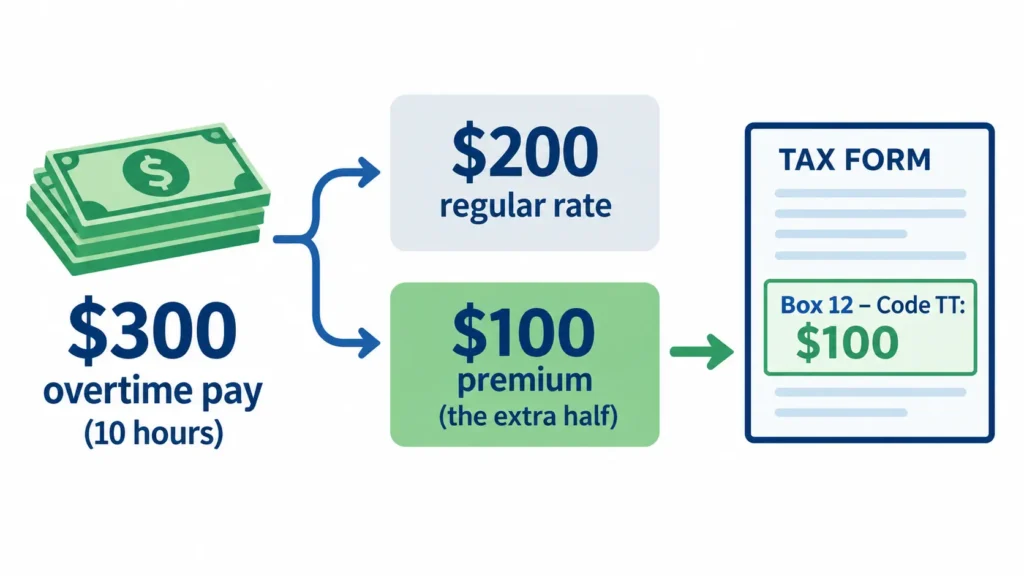
Your payroll record may show $300 of overtime for a week, but code TT will show only $100 of it. That is normal, because code TT counts only the extra half that the FLSA requires. For time-and-a-half pay, the full-year code TT is usually about one-third of your total overtime pay. For example, $18,000 of total overtime pay leaves about $6,000 in code TT.
Other differences can also come up. For instance, hours paid only under a state rule do not count. Also, the IRS generally counts overtime in the year you are paid, so pay that arrives in January may land on next year’s W-2. As a result, a small gap does not always mean an error. A very large gap, however, deserves a question to payroll.
Is TT in Box 12 or Box 14? What Changed From 2025 to 2026
On 2026 W-2s, code TT goes in Box 12. For tax year 2025, there was no code TT. Employers had transition relief, so they could report qualified overtime in Box 14 or in a separate statement, and the IRS waived penalties for not reporting it. For 2026, that relief ends, and code TT becomes the required location.
| Feature | 2025 W-2s (issued January 2026) | 2026 W-2s (issued January 2027) |
|---|---|---|
| Where the overtime premium is reported | Box 14 or a separate statement, optional | Box 12, code TT, required |
| Penalty relief for employers | Yes, under IRS Notice 2025-62 | No, standard penalties apply |
| How employees find their number | Use the employer’s number if given. Otherwise, figure it from pay records | Read it directly from the W-2 |
| Can pay stubs replace a missing amount? | Yes, using the IRS-approved methods | No |
| Overtime still in Box 1? | Yes | Yes |
How Much Can You Deduct With Code TT?
Code TT does not give every employee a full deduction. The federal deduction for qualified overtime is capped at $12,500 for single filers and $25,000 for married couples filing jointly. It applies to tax years 2025 through 2028. For a full breakdown, see the maximum overtime you can deduct.
How Does the Income Phase-Out Work?
The deduction also phases out at higher incomes. It starts to shrink when modified adjusted gross income (MAGI) passes $150,000 for single filers or $300,000 for joint filers. It drops by $100 for every $1,000 above that line. Finally, it reaches $0 at $275,000 (single) and $550,000 (joint).
Can Code TT Be Bigger Than Your Deduction?
Yes. Employees claim the deduction on Schedule 1-A of Form 1040, Part III. Suppose your employer reports $30,000 in code TT. Your deduction is still capped at $12,500 ($25,000 on a joint return), and a high income may cut it further. Employers must report the full amount they paid, even above the cap.
Overtime is also still subject to federal income tax withholding, Social Security tax, and Medicare tax. The deduction lowers your income tax at filing time. It does not change your paycheck or your payroll taxes. To understand the timing, read how the deduction works at filing time.
What If Code TT Is Wrong or Missing?
For 2026 and later, you can only deduct the qualified overtime that your employer reports on your W-2 in Box 12, code TT. Pay stubs are not enough. Therefore, fix any error before you file.
If the Amount Is Too Low or Missing
Ask your employer for a corrected Form W-2c. If your employer will not fix it, you can only use the lower number on the W-2. In addition, Form 4852 (substitute W-2) cannot be used for this deduction.
If the Amount Is Too High
You can only use what you were actually paid. For example, suppose you were paid $5,000 of qualified overtime, but the W-2 says $10,000. In that case, you can use only $5,000.
If You Are Not Sure
First, add up the FLSA premium from your pay stubs for the year. Then, compare it with code TT. If the two are far apart, ask payroll to explain the difference before you file.
If you already filed with the wrong amount, you may need to amend your return.
What Do “Qual OT” and “FLSA Wages” Mean?
“Qual OT” is short for qualified overtime. It is the same idea that code TT reports. Some employers used a pay-stub line or a Box 14 label for it in 2025, and the wording varies from company to company. Labels such as “FLSA wages” usually point to the same idea.
However, if a label confuses you, ask payroll which line matches the FLSA premium. In 2026, the number that counts is the one in Box 12, code TT.
For Employers: How to Get Code TT Right
Employees come to this page for answers, but employers decide the number. Therefore, this section is for payroll teams.
Why Is Classification the Biggest Risk?
Most articles focus on how to calculate the premium. However, the bigger risk is classification. If a payroll system marks a salaried exempt employee as eligible, or lumps state daily overtime into the FLSA bucket, the number is wrong before anyone runs a formula.
Therefore, it pays to confirm FLSA status for every employee before December, instead of rebuilding calculations at year end. A correct earnings code for the FLSA premium, separate from every other overtime type, does more for accuracy than any spreadsheet.
A Practical Check Before Year-End
Before your W-2s print, review your system with a few simple steps:
- Pull a year-to-date FLSA premium report for each non-exempt employee.
- Confirm that exempt employees show zero in the code TT field.
- Check one employee with multiple rates or a bonus by recalculating a single week by hand.
- Confirm that state-only daily overtime is excluded from the total.
- Count comp time for government employees when it is paid, not when it is earned.
Then, compare the result with the premium you expect. If the number looks far higher than expected, something in the category setup is likely wrong.
What Are the Deadlines and Penalties?
Employers must furnish Forms W-2 to employees and file Copy A with the Social Security Administration by February 1, 2027. Missing or incorrect code TT entries fall under the standard information return penalties in Sections 6721 and 6722. If an employer finds an error in code TT, it must file a corrected Form W-2c and give a copy to the employee.
Penalty amounts depend on how late the correction is, and they change with inflation. Therefore, check the IRS General Instructions for Forms W-2 and W-3 for current figures.
Frequently Asked Questions
What does TT mean on a W-2?
TT is a Box 12 code for qualified overtime compensation. It shows only the extra half of your federally required overtime pay, not your total overtime.
Is TT in Box 12 or Box 14 on a W-2?
On 2026 W-2s, TT is in Box 12. Some 2025 W-2s show qualified overtime in Box 14 or on a separate statement instead.
Is code TT the same as my total overtime pay?
No. Code TT reports only the FLSA premium, which is the half above your regular rate. The full overtime pay still appears in Box 1 as taxable wages. For example, on $300 of overtime built on a $20 rate, only $100 goes in code TT.
Does code TT reduce my taxable wages?
No. Overtime stays in Box 1 and remains subject to federal income tax withholding, Social Security, and Medicare. Instead, code TT only identifies the portion you may deduct on Schedule 1-A of your Form 1040. As a result, the deduction lowers your income tax at filing time, not your paycheck.
What if my 2025 W-2 has no code TT?
That is expected. The 2025 forms did not include code TT, and IRS transition relief covered reporting for that year. Your employer may have shown the amount in Box 14 or on a separate statement instead. If so, use that number. Otherwise, you can figure the amount from your pay stubs, using the methods in IRS Notice 2025-69.
What if my employer will not correct code TT?
You can only use the amount shown on your W-2. First, ask in writing for a corrected Form W-2c. If your employer still refuses, you cannot replace the W-2 with a Form 4852 for this deduction.
Why is code TT smaller than my overtime pay?
Code TT counts only the extra half that the FLSA requires. For time-and-a-half pay, that is usually about one-third of your total overtime pay. The rest is your regular rate, so it does not qualify.
Can I use my pay stubs if code TT is missing in 2026?
No. For 2026 and later, only the amount reported in Box 12, code TT, counts. Pay stubs help you check the number, but they cannot replace it.
Does code TT mean I will get that amount back as a refund?
No. Code TT is the amount you may deduct, not the amount you get back. Your tax bracket decides the savings, and overtime keeps your normal tax rate. For real numbers, see overtime deduction examples at different income levels, or estimate your possible refund.
The Bottom Line
Code TT is a clear, useful number once you understand what it measures. It captures only the federally required overtime premium, and it sets the upper limit for your deduction. If it is wrong, ask for a corrected W-2c before you file. As a final step, check eligibility first, then check the math, and run your numbers in the overtime tax calculator only after you are confident your inputs are right. This guide is general information, not tax advice.
Sources and Further Reading
- IRS Fact Sheet FS-2026-13 (August 2026): https://www.irs.gov/pub/taxpros/fs-2026-13.pdf
- IRS Notice 2025-62 (employer relief for 2025): https://www.irs.gov/pub/irs-drop/n-25-62.pdf
- IRS Notice 2025-69: https://www.irs.gov/pub/irs-drop/n-25-69.pdf
- General Instructions for Forms W-2 and W-3 (draft): https://www.irs.gov/pub/irs-dft/iw2w3–dft.pdf
- Instructions for Form 1040 (Schedule 1-A): https://www.irs.gov/pub/irs-pdf/i1040gi.pdf

Hi, I’m Sultan Mehmood, founder of NoTaxOnOvertimeCalculator.net. I started this site in 2026 to make overtime pay and tax topics easy to understand. I create simple calculators and clear guides on overtime pay, tax deductions, and take-home salary.