
Overtime Tax Calculator: Quick Overview
Overtime pay feels like a win — until tax season raises questions. Many workers assume their overtime is taxed differently, or wonder how the federal overtime (tax years 2025–2028) deduction actually applies to them. An overtime tax calculator answers that question, and this guide explains it clearly, step by step.
Importantly, this article is purely informational. It does not offer tax advice, and it is not a substitute for a licensed tax professional. Instead, it explains how the calculation works so you can estimate your own numbers using our free overtime tax calculator before filing your return.
Table of Contents
- Overtime Tax Calculator: Quick Overview
- Overtime Tax Calculator: How the 2026 Deduction Works
- What Is an Overtime Tax Calculator?
- How Overtime Pay Is Actually Taxed
- Who Actually Qualifies for This Deduction?
- The Federal Overtime Deduction (Tax Years 2025 — 2028) , Explained Simply
- How the Deduction Is Calculated, Step by Step
- Overtime Tax Savings by Income Level
- Does This Deduction Affect State Taxes Too?
- When the Deduction Starts Phasing Out
- Overtime Tax Calculator vs. Overtime Pay Calculator
- Where This Shows Up on Your W-2
- Common Mistakes People Make
- Frequently Asked Questions
Overtime Tax Calculator: How the 2026 Deduction Works
For tax years 2025 through 2028, a federal rule allows eligible workers to deduct a portion of their overtime pay from taxable income. This isn’t a blanket exemption — it works within specific limits tied to your pay structure, filing status, and income level.
A dedicated calculator brings this rule to life by turning your rate, hours, and filing status into a real dollar estimate, instead of leaving you to guess. Specifically, it factors in:
- Your tax year (2025 or 2026), so it uses the right tax brackets and standard deduction
- Your filing status (single or married filing jointly), since joint filers get a higher cap and phase-out threshold
- Your regular hourly rate, so it can isolate the qualifying premium (half of your regular rate)
- Your average weekly overtime hours and the number of weeks you worked
- Your estimated annual MAGI, to check whether you fall in the full-deduction range or a reduced one
The calculator currently supports tax years 2025 and 2026. We’ll add later years as the IRS publishes updated figures.
In practice, this means two workers earning identical overtime pay can end up with very different estimated savings once income and filing status are factored in. That’s exactly the gap a purpose-built calculator is meant to close — turning a complex federal rule into a clear, usable number before you file.
What Is an Overtime Tax Calculator?
This tool estimates how much of your overtime pay may qualify for a tax benefit, not just your gross overtime earnings. In other words, it goes a step further than a basic pay calculator.
Specifically, it factors in:
- Your regular hourly rate
- Your overtime hours worked
- The federal overtime deduction (tax years 2025–2028)
- Applicable income limits and filing status
As a result, you get a clearer, more realistic picture of your potential tax savings, not just your paycheck total. Not sure where to begin? Here is how to use an overtime tax calculator, one field at a time.
How Overtime Pay Is Actually Taxed
A common myth suggests overtime is taxed at a special, higher rate. However, that is not accurate. Overtime pay is added to your regular wages and taxed as ordinary income, using your normal tax bracket.
That said, many paychecks feel more heavily taxed during overtime weeks. This happens because payroll systems often annualize a larger paycheck, temporarily withholding more than necessary. Fortunately, this difference typically balances out when you file your return.
Key takeaway: Overtime is not penalized with a special tax rate — it simply gets added to your total taxable income for the year.
Additionally, it helps to understand why this confusion is so common. Payroll withholding tables are built around estimated annual pay, so any unusually large paycheck — whether from overtime, a bonus, or extra shifts —triggers a temporarily higher withholding rate.
Once your total yearly income is calculated at tax time, however, the math corrects itself, and most workers see the excess withholding returned as part of their refund. See how overtime withholding works to compare it with the deduction.
Who Actually Qualifies for This Deduction?
Not every worker who logs extra hours automatically qualifies. Eligibility depends on employment classification, not job title or industry. Specifically, the deduction generally applies to:
- Non-exempt employees (hourly or salaried) covered under federal overtime law
- Generally W-2 employees (most independent contractors and freelancers aren’t covered by overtime rules)
- Workers whose employer legally owes them time-and-a-half pay
- Overtime required only by state law or a union contract, or paid voluntarily by your employer, generally doesn’t count unless federal overtime law also requires it.
On the other hand, salaried employees classified as “exempt” typically do not qualify, since they are not legally entitled to overtime pay in the first place. This is precisely why some workers see a $0 result when using this tool — it usually reflects their employment classification, not a calculation error.
To test your job type, filing status, and income against every rule, follow this step-by-step eligibility checklist.
The Federal Overtime Deduction (Tax Years 2025 — 2028), Explained Simply
The federal government introduced a temporary overtime tax deduction as part of a broader tax law update, applying to tax years 2025 through 2028. This deduction directly reduces taxable income for eligible workers.
Here are the core rules:
- Only the premium portion of overtime qualifies — the extra half above your regular hourly rate
- The maximum deduction is $12,500 for single filers and $25,000 for joint filers
- The benefit phases out gradually once income crosses $150,000 (single) or $300,000 (joint)
- Eligibility generally applies to non-exempt W-2 employees (hourly or salaried) under federal labor law
- Social Security and Medicare taxes remain unaffected
- It is a deduction, not an exemption: it lowers your taxable income but does not reduce your AGI
Because of these rules, understanding “qualified” overtime is essential before estimating any savings.
How the Deduction Is Calculated, Step by Step
To make this concrete, consider a worker earning $20 per hour, with an overtime rate of $30 per hour.
- Identify the premium: $30 − $20 = $10 per overtime hour
- Multiply by annual overtime hours: 300 hours × $10 = $3,000
- Compare to the yearly cap: $3,000 is well below the $12,500 limit
- Apply your tax bracket: This amount reduces taxable income, not the tax bill directly
Consequently, the deduction lowers what you owe. It does not eliminate overtime tax. Once you have your number, follow this guide on how to claim the overtime deduction on your return. Already filed without it? You can still amend your tax return to claim it later.
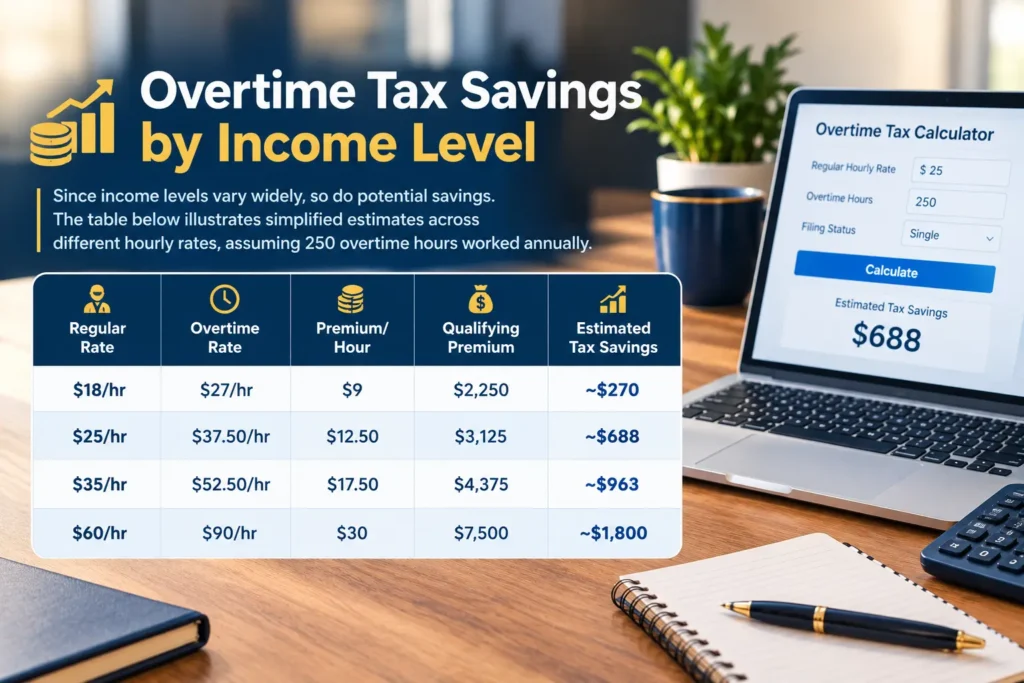
Overtime Tax Savings by Income Level
Since income levels vary widely, so do potential savings. The table below illustrates simplified estimates across different hourly rates, assuming 250 overtime hours worked annually.
| Regular Rate | Overtime Rate | Premium/Hour | Qualifying Premium | Estimated Tax Savings |
|---|---|---|---|---|
| $18/hr | $27/hr | $9 | $2,250 | ~$270 |
| $25/hr | $37.50/hr | $12.50 | $3,125 | ~$375 |
| $35/hr | $52.50/hr | $17.50 | $4,375 | ~$963 |
| $60/hr | $90/hr | $30 | $7,500 | ~$1,800 |
These figures are simplified estimates, not exact tax calculations. Estimated savings equal the qualifying premium multiplied by the assumed tax bracket, so a higher bracket means a bigger dollar benefit.
Notably, higher earners see larger dollar savings, but they are also more likely to approach the income phase-out threshold, especially in dual-income households.
None of these examples come close to the $12,500 or $25,000 annual caps. The cap mainly affects workers with very heavy overtime at a high hourly rate, for example, roughly 400 or more overtime hours at $60 per hour. For most workers, neither the cap nor the phase-out applies, and your savings depend on the size of your premium and your tax bracket. For a fuller estimate by income and filing status, use our overtime tax refund calculator.
Does This Deduction Affect State Taxes Too?
Generally, no. This is a federal-only deduction, meaning it reduces what you owe on your federal return. However, state tax rules operate independently, and most states have not adopted a matching overtime deduction.
As a result, your overtime wages may still be fully taxable at the state level, even after you deduct up to the federal limit on your return.. A handful of states with no income tax at all are unaffected by this distinction, but in most others, it’s worth checking your specific state’s rules before assuming your entire overtime paycheck becomes tax-free.
When the Deduction Starts Phasing Out
As income rises past the threshold, the deduction gradually shrinks rather than disappearing instantly. The deduction is reduced by $100 for every $1,000 of MAGI above $150,000 (single) or $300,000 (joint). Smaller deductions end sooner. For example, a $3,000 deduction reaches $0 at $180,000 MAGI.
This matters most for:
- Married couples with combined high household income
- Workers who consistently log heavy overtime hours
- Households with additional income sources, such as investments
Therefore, anyone nearing these limits should calculate their exact numbers rather than assume the full deduction applies.
Overtime Tax Calculator vs. Overtime Pay Calculator
These two tools sound similar, yet they serve different purposes altogether.
Overtime Pay Calculator:
- Calculates gross overtime earnings only
- Uses hourly rate × hours × multiplier
- Does not factor in taxes or deductions
This Deduction-Focused Tool:
- Estimates your federal tax savings from the overtime deduction
- Includes the new federal deduction
- Reflects income limits and filing status
In short, if your goal is understanding tax savings rather than gross pay, the second option is the right tool.

Where This Shows Up on Your W-2
Starting with tax year 2026, employers must report qualified overtime in Box 12, Code TT of Form W-2. This amount is already part of your Box 1 wages. It is the premium portion of your overtime, reported in full even if the cap or phase-out means you can’t deduct all of it.
For tax year 2025, employers weren’t required to report it, so most workers used their pay stub records. For 2026 and later, you generally can’t deduct more than the amount reported on your W-2. If it looks wrong, ask your employer for a corrected W-2c.
Common Mistakes People Make
Even with a reliable calculator, small misunderstandings can lead to inaccurate expectations. Avoid these common errors:
- Assuming your entire overtime paycheck qualifies, rather than just the premium
- Forgetting that state taxes may still apply, since not all states follow this federal deduction
- Believing FICA (Social Security and Medicare) is reduced, when it is not
- Expecting a $0 result to mean an error, when it usually reflects exempt employment status
Avoiding these mistakes leads to far more realistic expectations before tax season arrives.
Frequently Asked Questions
Is overtime pay taxed at a higher rate?
No, it is taxed as ordinary income at your standard tax bracket, not a special overtime rate. Many workers assume otherwise because payroll systems sometimes withhold more during high-overtime paychecks. That extra withholding is a timing quirk, not a real rate difference, and it typically balances out once you file.
Why does my result show $0 savings?
This usually means you’re classified as an exempt employee under federal labor law, which excludes you from mandatory overtime pay altogether. Since there’s no qualifying overtime premium in that case, there’s nothing to deduct. A $0 result reflects your employment classification, not an error in your inputs.
What information do I need to run an accurate estimate?
The calculator asks for your filing status, regular hourly rate, average weekly overtime hours, weeks worked per year, and estimated MAGI (including overtime). It assumes time-and-a-half overtime and applies the cap and phase-out automatically. The more accurate your inputs, the closer the estimate will be to your actual outcome at filing time.
Can I claim this deduction with the standard deduction?
Yes, this benefit is available whether you itemize or take the standard deduction. It lowers your taxable income but does not reduce your AGI, and you claim it on Schedule 1-A. Because you don’t have to itemize, most eligible workers can use it.
How long will this deduction be available?
Currently, it applies to tax years 2025 through 2028, unless Congress extends or changes it through future legislation. That gives eligible workers a limited window to benefit from this rule as it stands today. It’s worth rechecking the rules each filing season in case anything shifts.
Do independent contractors qualify for this deduction?
Generally, this deduction is for employees whose employers must pay overtime under federal law (the Fair Labor Standards Act). Some workers paid on Form 1099 may qualify only if federal overtime law actually requires overtime pay for their work. Check IRS Fact Sheet FS-2026-13 for the details, or ask a tax professional.
Will this deduction lower my paycheck withholding immediately?
Not automatically. Your employer can’t reduce withholding for this deduction unless you submit an updated Form W-4 (Step 4(b) on the 2026 form). Otherwise, your regular paycheck withholding stays the same, and most workers see the benefit at filing time, often as part of a larger refund.
Where can I read a full breakdown of how this deduction works?
For a complete walkthrough — including MAGI phaseouts, W-2 reporting, and worked examples by income level, see the complete breakdown. It covers every eligibility rule in more depth than this quick-estimate tool can, so you can confirm your exact numbers before filing.
Final Thoughts
Understanding how an overtime tax calculator works helps you set realistic expectations before tax season arrives. It turns confusing tax rules into a clear, personal estimate based on your own rate and hours. As the 2026 deduction rolls out, checking your numbers early can prevent surprises when you file. A quick calculation today saves guesswork later.
Sources: IRS Schedule 1-A (Form 1040) and IRS Fact Sheet FS-2026-13. Last updated: October 2026.
This article is for general informational purposes only and does not constitute tax, legal, or financial advice. For guidance specific to your situation, please consult a qualified tax advisor or accountant before making financial decisions.

Hi, I’m Sultan Mehmood, founder of NoTaxOnOvertimeCalculator.net. I started this site in 2026 to make overtime pay and tax topics easy to understand. I create simple calculators and clear guides on overtime pay, tax deductions, and take-home salary.